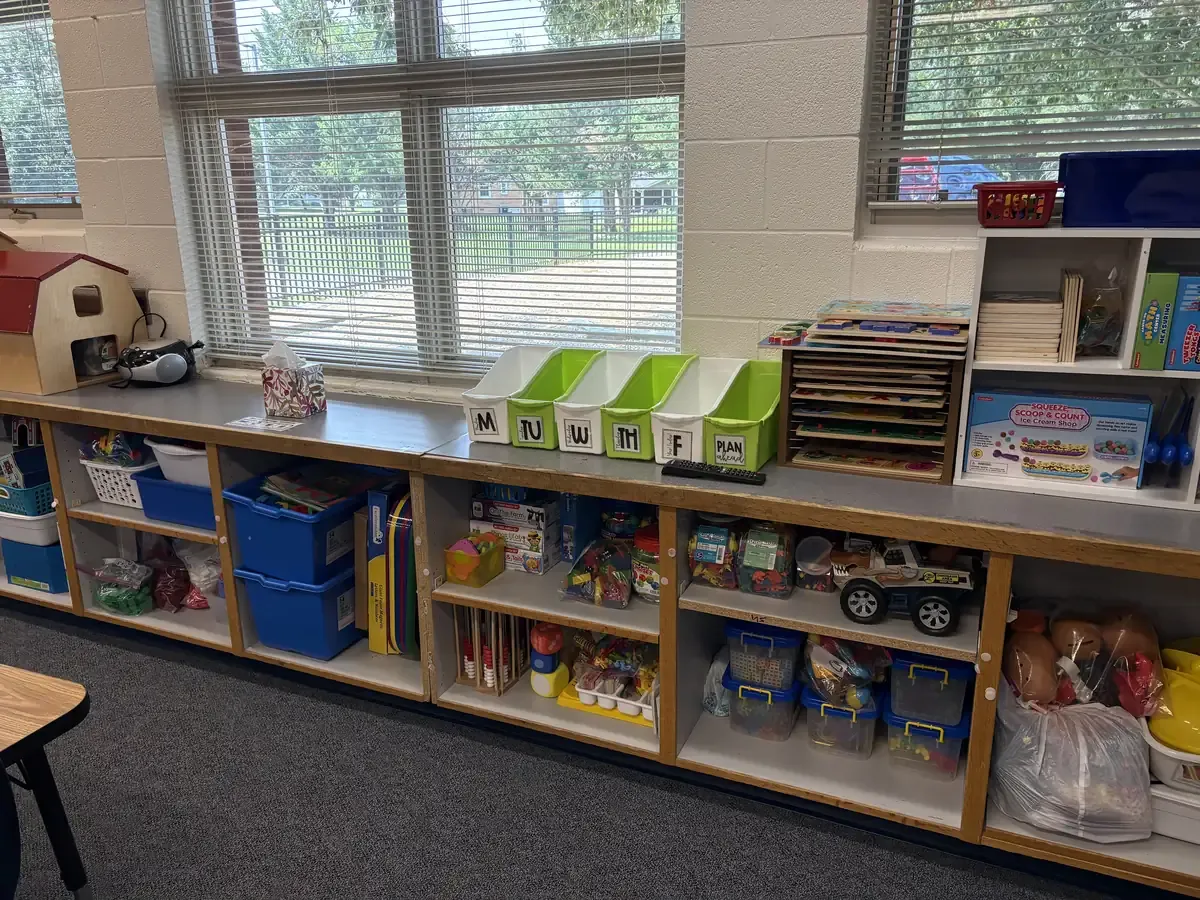
Start a preschool classroom setup by taking everything off the shelves—not to throw it out, but to see what you actually have. Then sort by one question: can a child get this themselves, or should they not be able to? That single decision places almost everything. Buy supplies last, if at all.
What follows comes from a preschool room I worked in recently, so the heights and the safety rules are written for three- to five-year-olds. The method underneath it — empty the shelves, sort by who reaches it, shop last — works in any classroom you’ve inherited from someone else.
How do I set up a preschool classroom I didn’t choose?
Most advice about setting up a classroom assumes you’re starting with an empty room. Almost nobody is.
Usually, you walk into a room the previous teacher left, and it’s full. Full of good things, mostly — the accumulated supplies of someone who taught there for years and organized it in a way that made sense to her. The shelves are stocked. The bins are labeled in someone else’s handwriting. And you can’t find anything, because the logic of the room isn’t yours yet.
That’s not a decluttering problem. That’s an inheritance problem, and it needs a different fix.
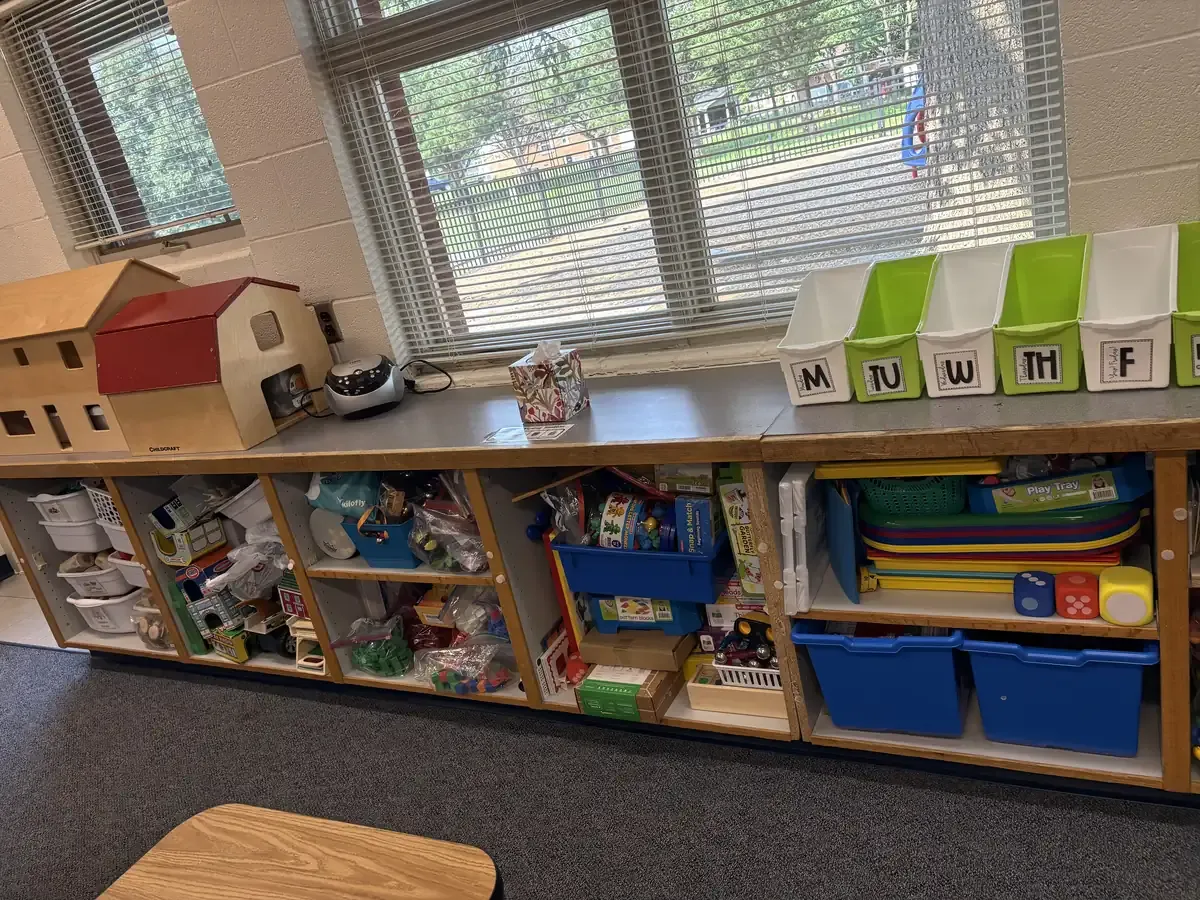
Here’s the order that works:
1. Take it all off the shelves. Every bin, every stack, onto the tables and the floor. This feels like the wrong direction, and it is the most important step. You cannot make decisions about a room when you can only see the front two inches.
2. Go through it yourself. Not with a helper doing it for you — you, hands on it. You need to know what’s in this room, because in October you’re going to need something, and the only useful thing is remembering you have it. This is slower than letting someone else sort, and it’s the part that actually pays off.
3. Sort by who reaches it, not by what it is. This step makes a preschool room work, and it’s covered in detail below.
4. Put it back in that order. Child-accessible: low and open. Everything else high, closed, or both.
5. Shop for the gaps, if there are any. There usually aren’t many.
Why shouldn’t I buy anything yet?
Because you almost certainly inherited more than you think, and because the money is yours.
AdoptAClassroom’s 2025 survey found that teachers spent an average of $895 out of pocket on classroom supplies during the 2024–25 school year — a 49% increase over a decade. The median supply budget schools provided was $200, and 97% of teachers said it wasn’t enough. The NEA reports that supply costs rose about 7.3% heading into the school year, nearly triple the overall inflation rate.
New teachers get hit hardest by this because, when you’re overwhelmed, the instinct is to buy your way to order. Bins feel like progress. A cart of matching containers feels like a plan.
But you can’t know what containers you need until you know what’s staying and where it lives. Buy first, and you’ll end up with bins that don’t fit the shelf, labels for categories you abandon in September, and a receipt you’d rather not look at.
This is the same sequencing problem I’ve written about for home decluttering and for small closets — decisions first, hardware last. The difference in a classroom is what the decisions are actually about.
Do I need to get rid of things?
Probably not much. And this is where classroom organizing genuinely differs from organizing a house.
In a home, most clutter is surplus. People keep clothes they’ll never wear, and containers they’ll never fill, and the honest answer is usually that a lot of it should go.
A preschool classroom isn’t like that. The construction paper will get used. The counting bears will get used. The bin of fabric scraps will turn out to be exactly what you need in February. Very little of what’s in that room is genuinely surplus — it’s just in an order that was built by someone else, for a way of teaching that isn’t yours.
So the goal isn’t less. The goal is to make it visible and reachable for the right person.
Things worth actually removing are narrow: anything broken, anything with missing pieces that make it unusable, dried-out markers and paint, expired food items, and materials for a curriculum the school no longer uses. That’s usually a box or two, not a purge.
What are the two questions that decide everything?
When I worked on a preschool room recently, the teacher told me what she was worried about, and it came down to two things. She didn’t want the children getting into materials and making a bigger mess than they started with. She also needed to find things fast, without hunting.
Those two worries are the entire design brief. Every placement decision in the room answers one of them:
-
- Can a child get this on their own? If yes, it goes low, open, and labeled so a pre-reader can use it. If no, it goes above their reach, behind a door, or both.
-
- Do you need to grab this without looking? If yes, put it at your eye level, near where you use it, and keep it open. If no, it can go high or back.
That’s it. Two questions, applied to every item as it goes back on the shelf.
This works in early childhood because the room does teaching work on its own. Loris Malaguzzi, who founded the Reggio Emilia approach, described the environment as the third teacher — the idea that a well-arranged space instructs children without an adult saying anything. A low shelf a three-year-old can reach isn’t storage. It’s what lets her get her own materials and put them back, which is most of what independence looks like at that age.
I’m an organizer, not an educator. But that principle is the reason placement matters more in a preschool room than in almost any other space I work in.
What goes where in a preschool classroom?
Preschoolers are roughly 3 to 5 years old and around 37 to 45 inches tall. They can comfortably reach materials at about shoulder height and below — call it 30 inches. Anything you want them to leave alone needs to be meaningfully above that, not just slightly.
| What it is | Height | Open or closed | Why |
|---|---|---|---|
| Daily materials children use themselves | Under 30″ | Open, picture-labeled | They can get it and put it back without you |
| Rotating or seasonal materials | Above 54″ | Closed or lidded | Out of sight means it isn’t asked for daily |
| Scissors, staplers, small parts | Above 54″ | Closed | Safety, and adult-supervised use only |
| Cleaning supplies, sanitizer, medications | High | Locked | Required by licensing, not optional |
| Your daily teaching tools | Your eye level | Open | Speed — you grab these without looking |
| Bulk paper, backup supplies | Top shelf or closet | Closed | Accessed monthly, not daily |
Two things that change these numbers in practice:
-
- Climbers exist. If you have a child who climbs, “above reach” is not a safety plan. Put anything genuinely hazardous behind a latch, not just up high.
-
- Labels for pre-readers need pictures. A photo of what’s inside the bin, taped to the front, does more than any word label. Children who can’t read yet can still return things to the right place, which is the whole point.
Check your program’s licensing requirements for anything in the locked category. Those are rules, not suggestions, and they vary.
What if the classroom is small?
Small preschool classroom layout is mostly a floor-space problem, not a shelf problem.
Most states set a minimum of around 35 square feet of usable indoor space per child, and early childhood design guidance generally recommends more than the minimum for comfortable activity space. Storage eats into that number fast, which means in a small room every shelf has to earn its footprint.
Three things that help:
-
- Go up on the adult side, stay low on the child side. The wall space above 54 inches is essentially free storage you’re probably not using. Keep the floor-level zone open and uncluttered.
-
- Use low shelves as dividers. A shelf that separates the reading corner from the art table does two jobs—storage and zoning—without taking up a second footprint.
-
- Rotate instead of displaying everything. Not all the materials need to be out at once. A smaller selection on the open shelves is easier for children to use and easier for you to reset at the end of the day.
What do new teachers worry about versus what actually matters?
Most first-year teachers, I’d expect, worry about how the room looks. Themes, borders, coordinated colors, the kind of thing that fills a Pinterest board in August.
What actually matters is whether the room functions on a Tuesday in November when you’re tired.
Worth noting: early childhood guidance has been pushing back on heavy decoration for a while. Neutral backgrounds and less visual noise let the actual materials stand out, and young children are already managing a lot of sensory input. A calmer room isn’t a less-committed room.
The functional questions are less fun and more useful. Can a child put something back without help? Can you find the thing you need in under ten seconds? Is anything hazardous genuinely secured? Does the floor stay clear enough for eighteen small people to move around?
Get those right, and the decoration takes care of itself, on your schedule, once you know the room.
How long does a preschool classroom setup take?
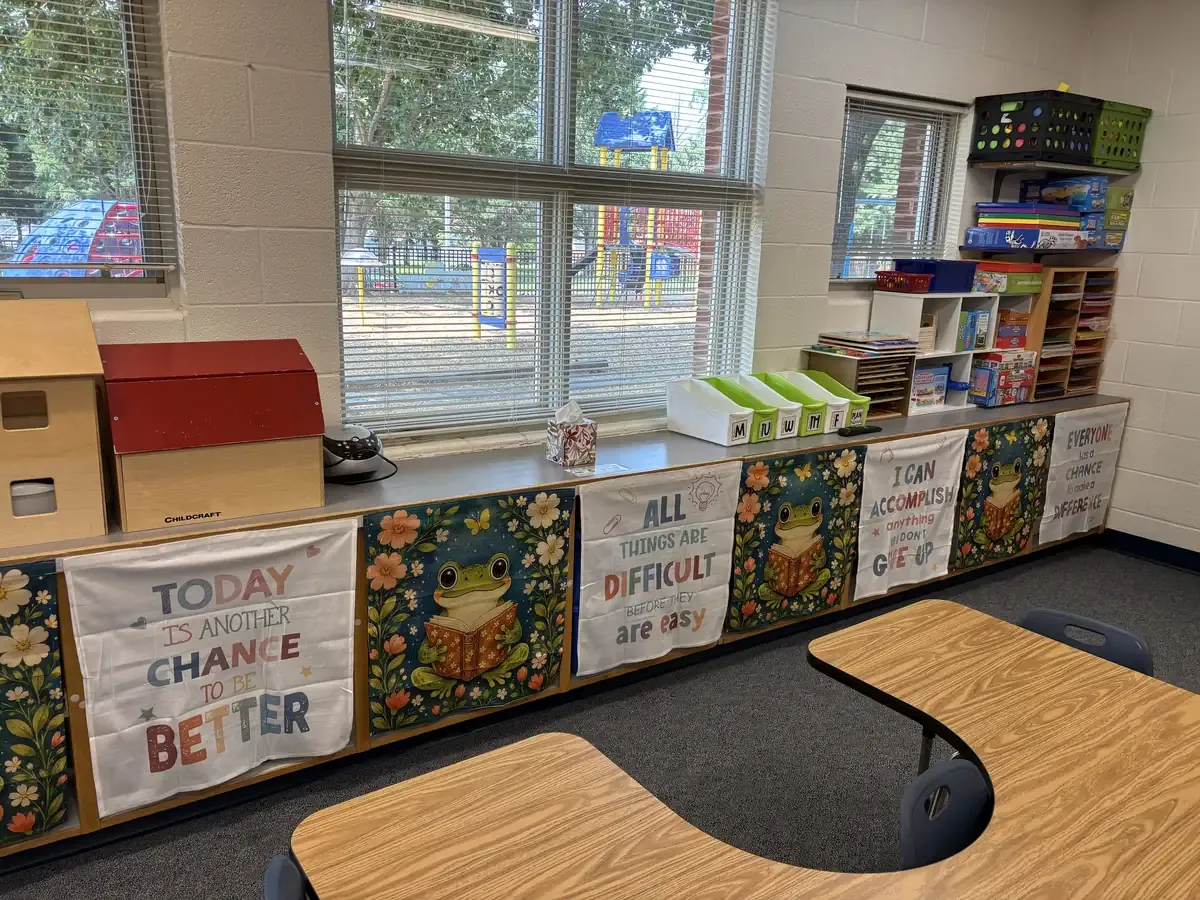
For a single classroom with inherited materials, plan on a full day if you’re doing it alone, or a long half-day with a second person.
The variable isn’t the room size. It’s how much is already in it and how quickly you can decide. Pulling everything off the shelves takes about an hour. Sorting takes time because every item is a small decision, and decisions slow down when you’re tired or unsure.
Having someone else there helps mostly by keeping the sorting moving. It also means the heavy shelf that needs to be moved actually gets moved, instead of staying where it is, because moving it alone is a problem for another day.
I charge $55 an hour with a three-hour minimum. If you want the full picture of how organizing gets priced around here, I wrote about that in what a professional organizer actually costs in Virginia.
Who is actually asking for this help?
Often, not the teacher.
The preschool job I recently took came through the teacher’s mother. She could see her daughter starting her first year and getting overwhelmed before day one, and she wanted her to start off on the right foot.
I was glad to do it. The room got sorted, the teacher could find what she needed, and she walked into her first week with one fewer thing pressing on her. That’s most of what this work is — not a transformation, just taking one weight off someone who was carrying several.
If you’re reading this about someone else, that’s worth knowing. Helping a new teacher get her room in order is a genuinely useful thing to give, and it lands in the exact week she needs it.
This is a busy season for it locally. The Northern Virginia Daily reported that Warren County Public Schools welcomed 42 new teachers at a late-July event, including career switchers and instructional assistants who came up through the division’s Grow Your Own program. The division opens for the year on August 12. That’s a lot of people setting up a classroom for the first time, on a short clock.
Can I do this myself?
Yes. The method above is the whole method, and there’s nothing in it that requires me.
Where a second person helps:
-
- You’re out of days. School starts, and the room isn’t done. Hiring compresses a project that would otherwise eat the weekend before your first week.
-
- You keep stalling on the sorting. Deciding what stays is the slow part, and it goes faster when someone asks out loud, “Are you going to use this?”
-
- Furniture needs to move. Layout changes that require two people usually don’t happen if you’re alone.
The Organized Kat is insured and female-owned, and I work in Winchester, Front Royal, Strasburg, Berryville, Leesburg, and Martinsburg, West Virginia. It’s a newer business, which I’d rather say plainly than dress up — what I bring is a straightforward process and no interest in selling you supplies you already own.
If you’re a teacher — or someone who loves one — and the room needs a hand before the first bell, book a free quote. And if you’d rather do it yourself this weekend, go do it. Start by taking everything off the shelves.