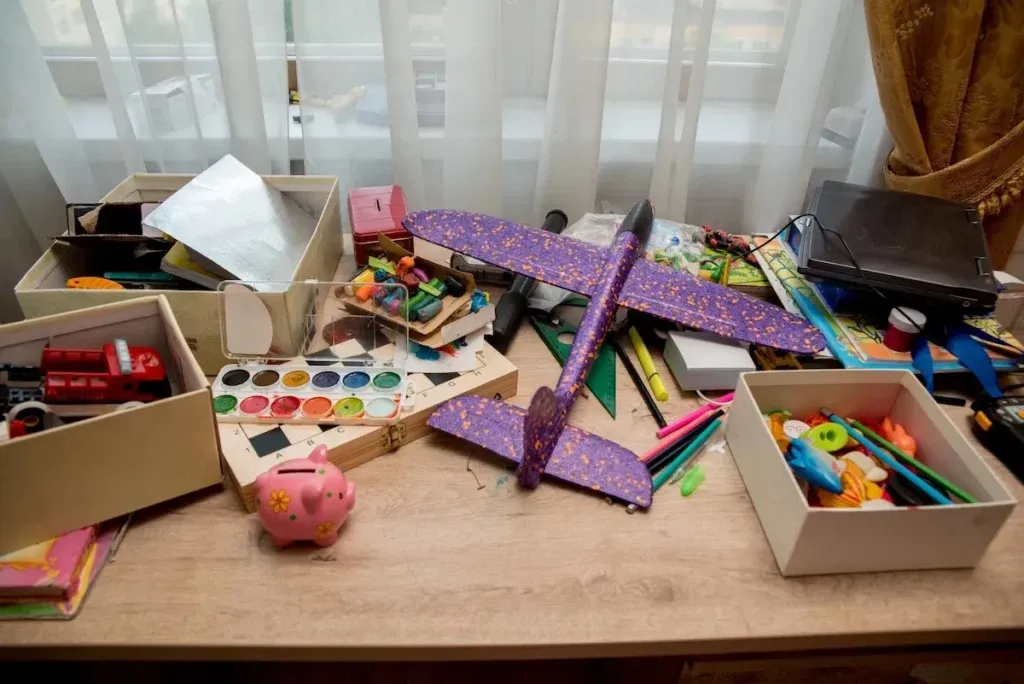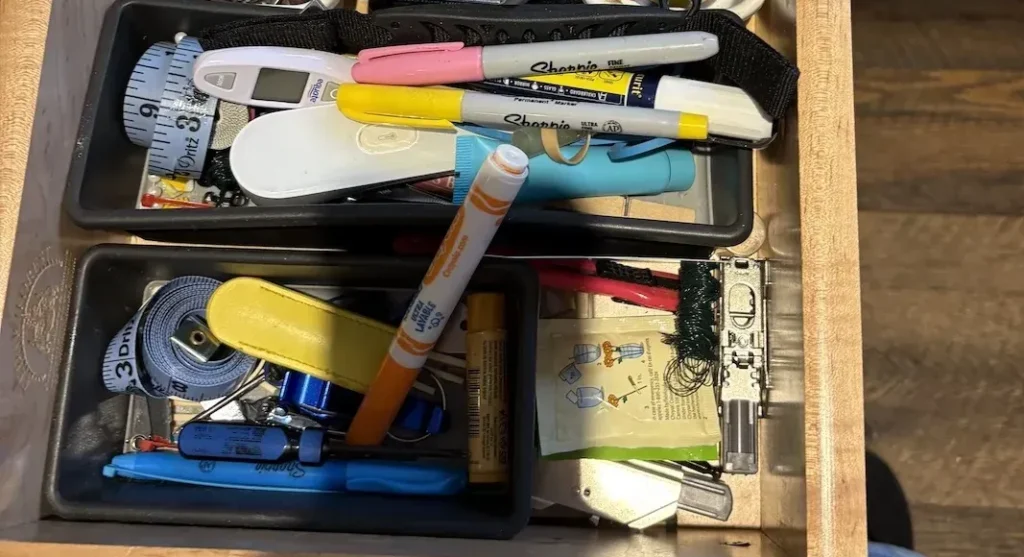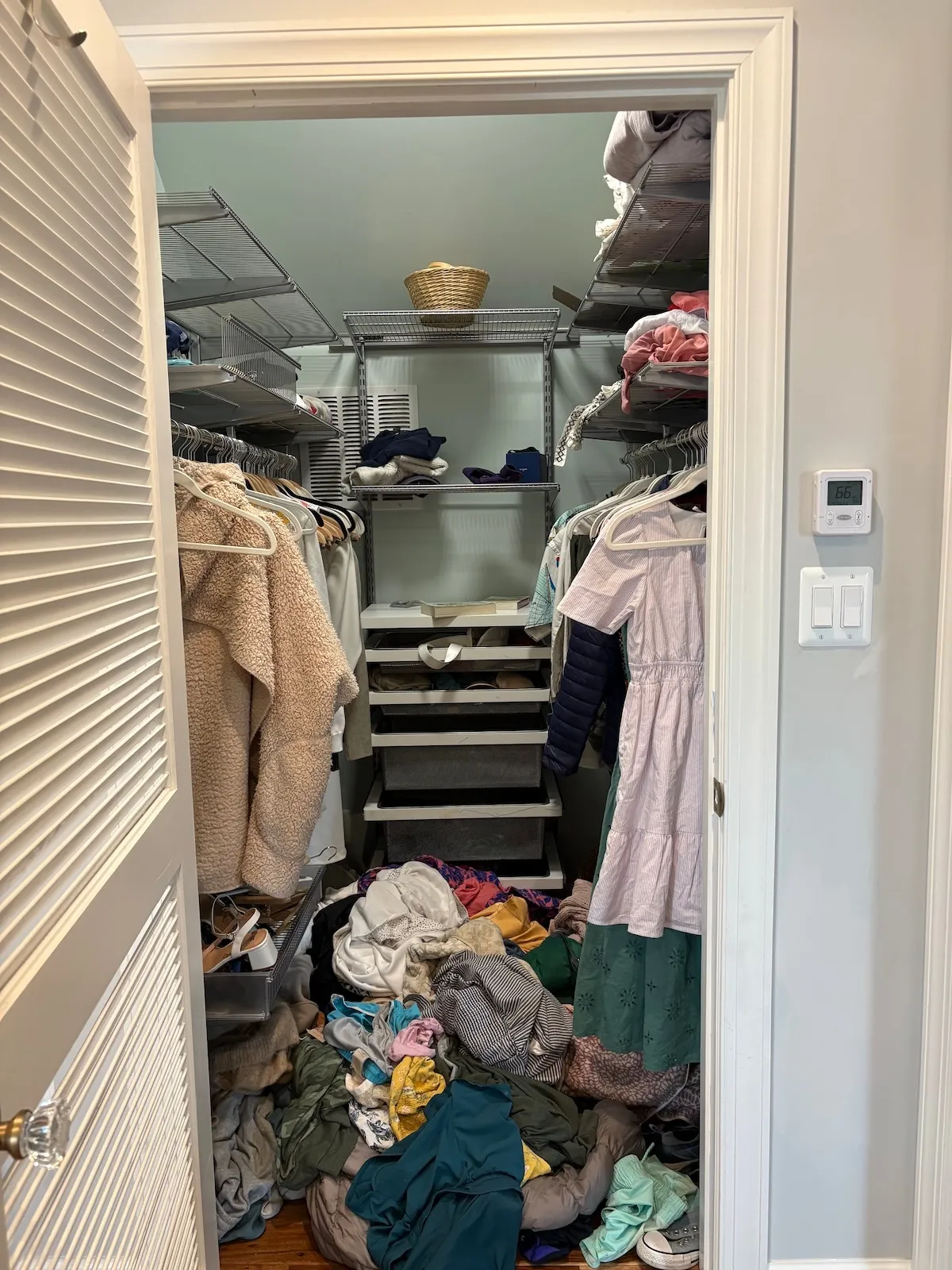
How to organize a small closet: take everything out, sort into keep, donate, sell, and toss, then measure your remaining hanging items before you buy anything. Most small closets aren’t too small — they’re holding clothes nobody wears. Fix the volume first. Buy hardware last, once you know what’s actually staying.
How to Organize a Small Closet, Step by Step
Five steps, in this order. The order is the whole point.
1. Empty it completely. Not “pull out a few things.” Everything, onto the bed. You cannot judge what fits in a space you can’t see. This part feels worse before it feels better, and that’s normal — plan for the room to look like a disaster for about an hour.
2. Sort into four piles, fast. Keep, donate, sell, toss. Set a timer and move. If you’re standing there holding a sweater for ninety seconds, it goes in the donate pile — hesitation is an answer.
3. Try on anything you’re unsure about. This is the step people skip, and it does the most work. “It might fit again someday” is not a decision. Putting it on is.
4. Measure what’s left. Count your hanging items. Measure your closet’s width and depth. Now you have two real numbers instead of a vague feeling that your closet is too small.
5. Put the keepers back by category, then by frequency. Put everything you wear weekly at eye level in the middle. Put seasonal and occasion items high or on the far edges. That’s it — no system required.
If the space you’re stuck on is a classroom rather than a closet, the method changes a little — here’s how I’d approach an inherited classroom.
Notice what’s missing from that list: shopping. You don’t buy anything until step five is done and you know exactly what’s left and where it lives. This is the same principle I wrote about in where to start decluttering — containers solve a storage problem, and most closets don’t have a storage problem. They have a volume problem.

Why shouldn’t I buy a closet system first?
Because you’d be paying to store clothes you’re about to get rid of.
The numbers here are not small. Angi’s May 2026 cost data puts custom closet installations between roughly $1,046 and $3,210, averaging about $2,128, at $30 to $50 per square foot. HomeGuide reports that prefab closet systems run $400 to $2,200 with installation, and installing one takes 4 to 16 hours of labor.
So the standard sequence looks like this: you feel overwhelmed by your closet, you spend $2,000 on a system designed around the wardrobe you currently own, and six months later you’re overwhelmed again — now with nicer shelving.
Here’s what makes this expensive instead of just inefficient. A 2025 study from KU Leuven and the University of Utrecht, published in the Journal of Circular Economy, examined actual wardrobes. It found that the average person owns close to 200 garments, one in five of which sits completely unused, and that 75% of those dormant items are still in good enough condition to be reused. Participants were unwilling to part with almost 60% of them, mostly because they intended to wear them at some point in the future.
Read that last part again. Your closet is full not because of storage design. It’s that most of us are holding a large reserve of clothing for a future that hasn’t arrived.
The UK’s WRAP found something similar at a national scale: the average adult keeps upwards of 118 items of clothing, and roughly a quarter of those — about 31 items — haven’t been worn in at least a year. Skirts and dresses were the least-worn categories, while staples like jeans, socks, and sweatshirts got used constantly.
A closet system doesn’t touch any of that. It just builds a more attractive home for it.
Do the decisions first. That’s the whole argument for organizing a small closet on a budget: sorting is free, and it’s the part that actually works.
What if I have too many clothes for the closet?
Then you have one of two problems, and each needs a different fix.
Problem one: you own more clothes than the closet was built to hold. This is the common one, and the fix is the sorting above. Cut the volume.
Problem two: you genuinely need the volume. Some people do. If you’re a nurse with scrubs, a realtor with client-facing outfits, and a wedding coming up, you may actually need more hanging space than a 1968 builder gave you.
If it’s problem two, here’s the order I’d work in:
- Split the seasons. Winter coats and heavy sweaters do not need to occupy prime real estate in July. Move the off-season half elsewhere — a guest closet, under-bed storage, the top shelf.
- Fold what folds. Jeans, sweaters, and T-shirts take less space folded than hung. Knits also hold their shape better folded. Hanging everything is a habit, not a rule.
- Add a second rod before you add a system. A double-hang setup on the short-garment section can roughly double your capacity in the exact same footprint. A tension rod or a hanging double-rod bar costs under $30.
- Relocate the non-clothing. Small closets fill up with things that aren’t clothes: gift bags, board games, a vacuum. Those go somewhere else.
Only after all four of those should you start pricing out cabinetry.
How much can a small closet actually hold?
This question ends most arguments about whether a closet is “too small.” Standard reach-in closets are about 24 inches deep, and industry guidance suggests planning for 2 to 2.5 inches of rod space per hanging item so clothes don’t get crushed. At that spacing, here’s what your width buys you:
| Closet width | Single rod | Double-hang | Realistic for |
|---|---|---|---|
| 4 feet (48″) | ~24 items | ~48 items | One person, edited wardrobe |
| 5 feet (60″) | ~30 items | ~60 items | One person, comfortable |
| 6 feet (72″) | ~36 items | ~72 items | One person, full wardrobe |
| 8 feet (96″) | ~48 items | ~96 items | Two people sharing |
A few notes that change these numbers in real life:
- Double-hang only works above 85 inches of usable height. Below that, the top rod is too low and long items drag.
- Long garments kill capacity. Dresses and coats need a single full-height rod, so you can’t double a section for them.
- Sliding doors cost you access, not space. A 6-foot closet with bypass doors only ever shows you half of itself. Factor that into where you put daily items.
- Under 24 inches deep, hangers hit the back wall. Older homes often come in at 18 to 20 inches, which means clothes hang at an angle and wear faster at the shoulder.
Compare your count from step four against this table. If your keep pile is 90 items and you have a 5-foot single-rod closet, the table just told you something a $2,000 system never would.
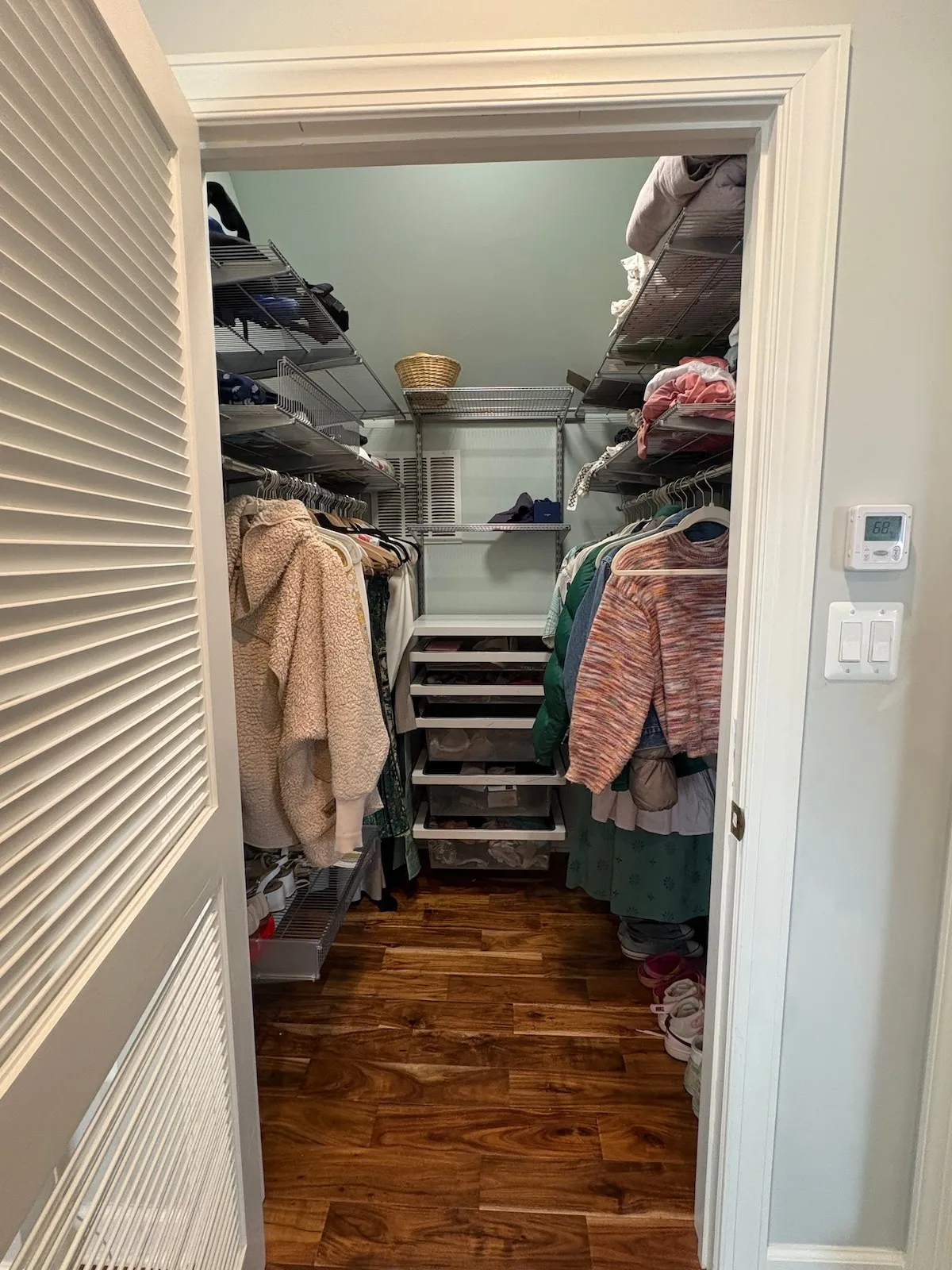
This one’s a walk-in, but the principle is identical: the floor didn’t appear because we added shelving. It appeared because the volume came down first.
Why are closets so small in older Winchester homes?
Because they weren’t designed for the amount of clothing we own now.
Winchester’s housing stock skews old. According to Census-based figures, the median construction year for a home in Winchester is 1968, and about 18.4% of homes were built before the 1940s, with another 11.5% going up by 1949. That means close to a third of the city’s homes predate 1950 — and closets from that era were built for a wardrobe of maybe a few dozen garments, not two hundred.
That has practical consequences when you start mounting things:
- Plaster and lath won’t hold a heavy system. Anchors that work fine in drywall pull straight out of century-old plaster. Anything load-bearing needs to find a stud.
- Nothing is square. Older closets are often out of plumb by an inch or more across their width, which is more than most modular systems can handle.
- Depth is often non-standard. A 19-inch-deep closet won’t accept a system built for 24 inches, and many prefab kits assume 24.
This is a real argument for doing the low-tech version in an older home: a well-placed second rod, good hangers, and an edited wardrobe will outperform a system that was never going to fit right anyway.
How long does it take to organize a small closet?
For a standard reach-in closet, plan on three to five hours if you’re doing it yourself and actually making decisions rather than shuffling.
The variable isn’t the closet — it’s the volume and the decision speed. A 5-foot closet holding 60 items goes faster than a 5-foot closet holding 160. Someone who can decide in three seconds goes faster than someone who needs to think about each piece.
Working with someone changes the math mostly because it changes the decision speed. Having a second person ask “when did you last wear this?” is what keeps a closet from turning into a four-hour nostalgia session.
I charge $55 an hour with a three-hour minimum, which for most single closets means the whole thing lands inside one session. If you want the full breakdown of how organizing gets priced in this area — and why the range you see online is so wide — I wrote about that in what a professional organizer actually costs in Virginia.
What should I buy — and when?
After the closet is sorted. Not before. Here’s roughly what’s worth it, in the order it matters:
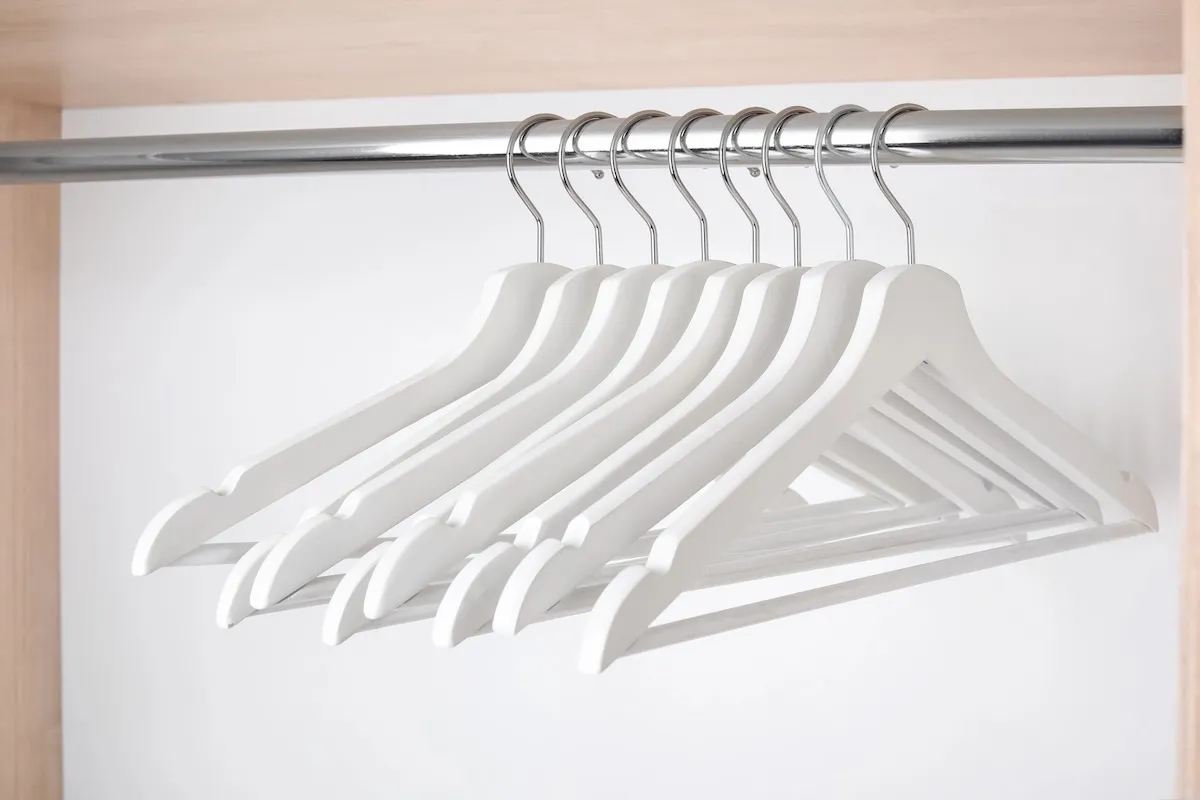
Matching hangers. The single highest-return purchase in closet organizing costs about $25. Slim velvet hangers reclaim real inches across a rod, and uniform hanger height makes a closet read as organized even when it’s full. Do this one first.
Add a second rod if you have short garments and vertical space. A hanging double-rod bar or a tension rod. Under $30. This is the cheapest capacity you will ever buy.
Shelf dividers. If your top shelf is a pile of collapsing sweaters, dividers fix it for around $15.
A small bin for the top shelf. One. For the genuinely seasonal things. Not eight.
A system, maybe. If, after all of the above, you’re still short on space, you now have a measured, honest case for one — and you’ll be buying a smaller configuration than you would have three weeks ago.
What I’d skip: shoe racks bought before you’ve counted your shoes, “closet organizer kits” purchased sight unseen for a non-standard closet, and anything decorative that doesn’t hold anything.
What do I do with the clothes that are leaving?
Get them out of the house within 48 hours. Bags that sit in the hallway have a way of getting unpacked.
Around Winchester and Frederick County, a few options:
- CCAP (Congregational Community Action Project) accepts clothing, linens, and personal items for local families, and serves Winchester and Frederick County directly.
- The Salvation Army Winchester Corps thrift store takes clothing, furniture, bedding, and household goods during business hours, and provides donation receipts.
- Horizon Goodwill Industries operates in the area and serves Frederick County.
- Consignment makes sense for a small number of high-value pieces. It isn’t worth your time for a bag of fast fashion—the sorting labor exceeds the return.
- Textile recycling for anything stained, torn, or genuinely worn out. Don’t donate damaged clothing; charities have to pay to dispose of it.
Hours and accepted items change, so call ahead before you load the car.
If the closet you’re clearing is part of a bigger move, the sequencing is different, and the stakes are higher — that’s covered in how to declutter before a move.
Can I do this myself, or should I hire someone?
Most people can absolutely do this themselves. How to organize a small closet isn’t a professional secret — the method above is the whole method.
Where a second person genuinely helps:
- You’ve started three times and stalled three times. The problem isn’t knowledge; it’s momentum, and momentum is easier to borrow than to generate.
- The clothes carry weight. Sizes you’re hoping to return to, clothing from someone who’s passed, a wardrobe from a job or a marriage that ended. These sessions go slowly and they go better with someone who isn’t emotionally involved.
- You want it done in one afternoon. Hiring compresses a project that would otherwise stretch across three weekends.
The Organized Kat is insured and female-owned, and I work in Winchester, Front Royal, Strasburg, Berryville, Leesburg, and Martinsburg, West Virginia. It’s a newer business, which I’d rather say plainly than dress up — what I bring is a straightforward process, real care for your stuff, and no interest in selling you bins you don’t need.
If you want a hand with a closet, book a free quote. And if you’d rather do it yourself this weekend — genuinely, go do it. Start by taking everything out.